

Staffing & capacity England
How to build a pharmacy consultation capacity plan
A useful capacity plan starts with the work your team is already doing. Measure demand, protect the time around each consultation and test a small change before increasing the booking diary.
Define the problem before adding appointments
Write down the pressure you want to relieve in one sentence. It might be patients waiting for a suitable consultation, the room being occupied when referrals arrive, or records being finished after the working day. Each problem needs a different response. Buying more consultation time will not solve a room that is unavailable or a handover process that repeatedly loses information.
For one or two representative weeks, keep a simple operational tally by day and time band. Count enquiries, referrals, patients offered an appointment, completed consultations, onward referrals and people who decline. Use totals without patient details for capacity planning. Keep any clinical information in the appropriate clinical record, with access limited to the people who need it.
Map the entire consultation, not just the conversation
Observe the work before and after a typical appointment. Include greeting the patient, checking the booking, preparing the room, supporting communication, the clinician's assessment, documentation and getting the room ready again. Do not assume every task runs in parallel. If the same colleague must support two steps, those minutes compete with one another.
Build separate estimates for different services and allow longer slots where patients need additional support. Start with observed ranges rather than the fastest consultation in your sample. Ask staff where interruptions occur and include protected time for breaks, urgent issues and follow-up. A timetable filled to its theoretical maximum leaves no room for variation.
Try an explicit example
Suppose a pharmacy can protect a two-hour afternoon session. For planning only, it sets aside 20 minutes per appointment and holds 20 minutes of the session for recovery, interruptions and unfinished work. That leaves 100 minutes, or five appointments. These are invented scheduling assumptions, not a recommended clinical consultation length.
Now check the same five slots against the room diary and supporting staff rota. If only three can be supported without interrupting another essential task, the practical starting capacity is three. If actual appointments regularly overrun, increase the allowance or change the session. Do not make the clinical conversation fit a spreadsheet by reducing necessary assessment time.
Check which work can move to video
Create a service-by-service eligibility list before assigning work to a remote pharmacist. For Pharmacy First in England, use the current NHS service documents to check the consultation method and pathway. A video connection does not authorise a service, a medicines supply or an arrangement between different contractors.
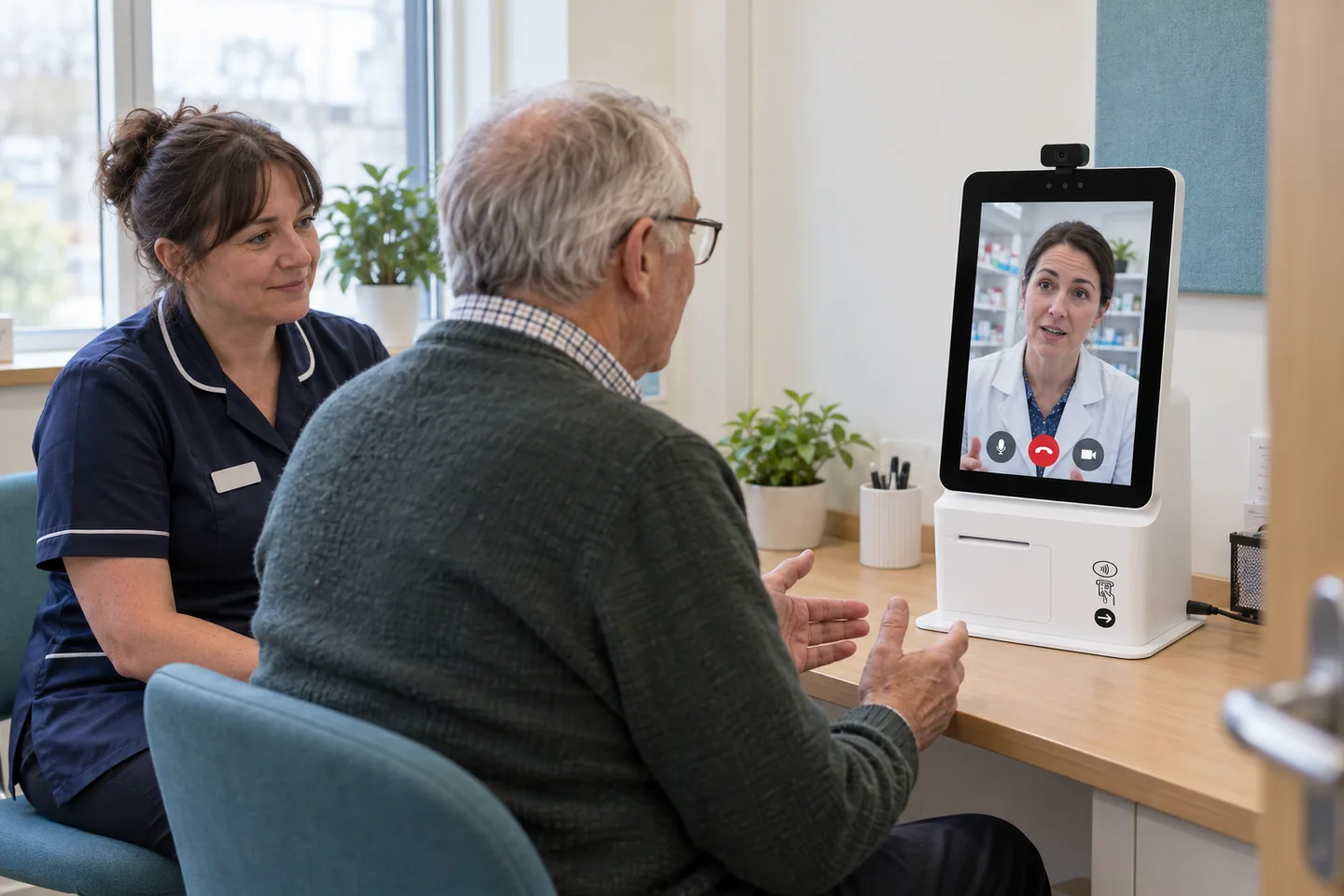
Remote Pharmacist adds consultation capacity alongside the on-site team. In our model the Responsible Pharmacist remains on site; remote sessions are not a substitute for that role or dispensing supervision. If the constraint is dispensary cover, assess the second on-site pharmacist option as a separate staffing decision.
Agree handovers and limits
Give each part of the journey an owner. Who checks whether the room is available? Who tells a waiting patient about a delay? Who acts if the remote clinician requests an in-person assessment? Name the person who checks that records and outstanding actions are complete at the end of the session.
Set a sensible limit on concurrent work. A colleague supporting a patient in the room cannot be assumed to cover the counter at the same moment. Agree how the pharmacy pauses bookings if staffing, room availability or connectivity changes. Make the pause process as familiar as opening the diary.
Review the first change against your baseline
Start with a defined set of sessions and keep the same counting method as the baseline. Review waiting time, appointments offered and completed, interruptions, record completion and staff feedback. Include people who could not use video so an apparently improved completion rate does not hide reduced access.
Compare cost with additional usable capacity, rather than attributing every consultation in the pilot to the change. Your existing team may have delivered some of that work anyway. The pilot evaluation guide explains how to record assumptions and decide whether to continue, adjust or stop.
Frequently asked questions
How many consultations should a pharmacy book each hour?
There is no single planning figure that suits every service and patient. Use local observations, include documentation and support time, and let the clinical team set appropriate appointment lengths.
Should we count patients sent elsewhere?
Yes. Record onward referral as a separate operational outcome. It may be the right clinical result and helps show whether the service is matching local needs.
Sources & further reading
Checked against the following sources on 1 October 2026. Service rules and payments can change; use the current specification and Drug Tariff when making decisions.
- NHS England: Pharmacy First service specification and clinical pathways
- GPhC: standards for registered pharmacies in Great Britain
This is business and service-planning information. It does not assess an individual patient, authorise a delivery model or replace local clinical and contractual decisions. Source checking is not a claim of independent clinical review.
Our editorial policy and corrections processSee it in your consultation room
A practical walkthrough, shaped around your team and the services you want to deliver.